
parenting
Partum and postpartum friends: the merino pants that carried me through
On oversized John Merino sweatpants, a patch cut from baby trousers, and the destruction and reconstruction of motherhood
Frogwise · 6 min read
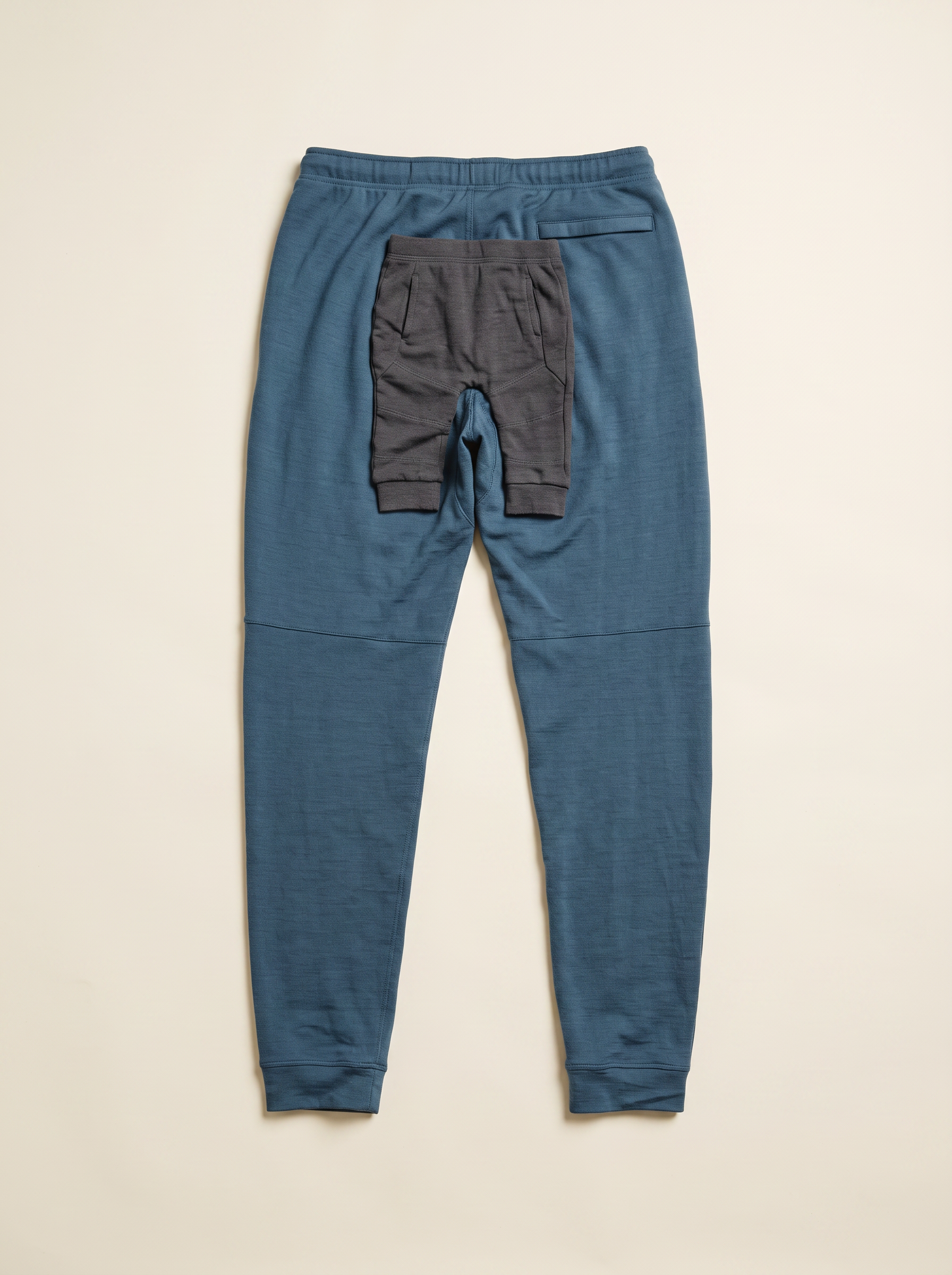
In short: I bought one pair of oversized men''s merino sweatpants early in pregnancy instead of a wardrobe of maternity clothes. They stretched, they lasted, they were worn almost daily for two years, and then they tore. Rather than replacing them, we patched them with a pair of my son''s baby trousers — clothes he had barely worn, because babies outgrow everything before it wears out. The result is a repair, a keepsake, and a small argument about how much clothing the world actually needs.
One pair of pants
Early in pregnancy you are told, gently and constantly, that you will need new clothes. A maternity wardrobe. Panels, bands, sizes that only make sense for four months.
I bought one pair instead: oversized men''s merino sweatpants from John Merino in Amsterdam. The logic was simple. Merino stretches and recovers. Oversized men''s cuts have no waistband that fights a changing body. If a garment can move with you rather than be replaced by you, it can stay.
They stayed. Through every trimester. Through the fourth trimester, which nobody warns you is a season of its own. Through a year of feeding, carrying, floor-sitting, and night walking. Almost every day. Partum, postpartum, and now — it seems — the toddler period.
The pocket with a zipper
The other reason I stuck with a men''s pair: pockets that actually work. Women''s trousers are still made with pockets that are decorative, too shallow for a phone, or sewn shut entirely — and then you are told to carry a bag. With a baby on one arm, a bag is one thing too many.
These have real, deep pockets, and one of them has a zipper. That single detail is the game changer. A phone stays put when you crouch to the floor, when you lie down to feed, when you walk the pram at 3am, when you bend over the changing mat. Nothing slides out, nothing gets left on a bench in a park.
It sounds small. It is not. Practical clothing is what lets you leave the house with your hands free, and women''s clothing is routinely designed as if that were never the point.
Then they broke
Clothes worn that often do eventually break. The pockets went first and were mended. Then holes opened across the seat, in the place where you sit on floors and benches and the edges of beds, and they became unwearable.
The honest next step, in most households, is a bin bag and a new pair.
The patch
We had a pair of my son''s baby trousers ready to pass on. Baby clothes in the early months are barely worn — a few weeks, sometimes a few wears, and the child has already outgrown them. Ours had come from friends, and knowing those friends, they had come from friends before that. I was about to pack them for the next family.
Then I looked at the colour. Dark, close to the blue of the merino, different enough to read as a deliberate mark and not a mistake. Nothing screaming, nothing red. A statement you have to stand near to notice.
So instead of cutting the baby trousers into fabric, my mother-in-law sewed them on whole. Two small legs, laid over the damage, still recognisably a pair of baby pants. Nothing was destroyed to make the repair. If someone needs them later, they are still there, still trousers.
A double patch of baby clothes across the seat of the sweatpants that carried the pregnancy that made the baby who wore them.
What the fashion industry could do instead
This is the part worth saying plainly. Baby clothing is the clearest case in the entire garment industry for circulation rather than production. The wear is minimal. The turnover is fast. The garments almost always survive their owner''s size.
And yet the industry keeps producing new ones, season after season, for a customer who will fit them for six weeks.
Everything about our pants ran the other way: bought once, worn to failure, repaired with something already in the house, and repaired in a way that keeps both garments alive.
Destruction and reconstruction
There is a metaphor here and I am not going to pretend otherwise.
Pregnancy and the years after are not a pause in a body — they are a rebuild. Tissue, bone density, sleep architecture, appetite, attention. The brain included. What gets dismissed as "mommy brain" is not decline; it is reorganisation. You lose the trivia and keep the essential: where the child is, what the sound meant, what happens next. It reads as forgetfulness from outside. From inside it is ruthless prioritisation. That is not weakness. It is one of the most powerful reallocations a mind will ever perform.
The pants did the same thing in cloth. They were worn down in the places that took the load, and then they were rebuilt with the material of the very thing that wore them down.
What I would take from it
- Buy the garment that can move with a changing body, not the garment sized for one phase of it.
- Merino is worth its price for this reason: it stretches, recovers, resists smell, and stays wearable for years of daily use.
- Baby clothes should circulate by default. Ours arrived from friends and were leaving for friends.
- Repair does not have to be invisible. A visible patch is a record.
- Repair does not have to be destructive either. Sewing the trousers on whole means they can still be trousers.
Thank you to my mother-in-law, who is a wonderful sewer and did this in an afternoon. I want to learn more of that — it is, quietly, one of the most useful skills there is.
- pregnancy
- postpartum
- circular fashion
- repair
- merino
- amsterdam
Pass it on
If this was useful to you, it is probably useful to someone you know.
Write to the editor
Questions, corrections, a different experience, or something we should research next — we read everything and answer in person.
Write about this articleNewsletter
One considered email, twice a month.
New guides, assessments and directory listings. No sponsored noise.

